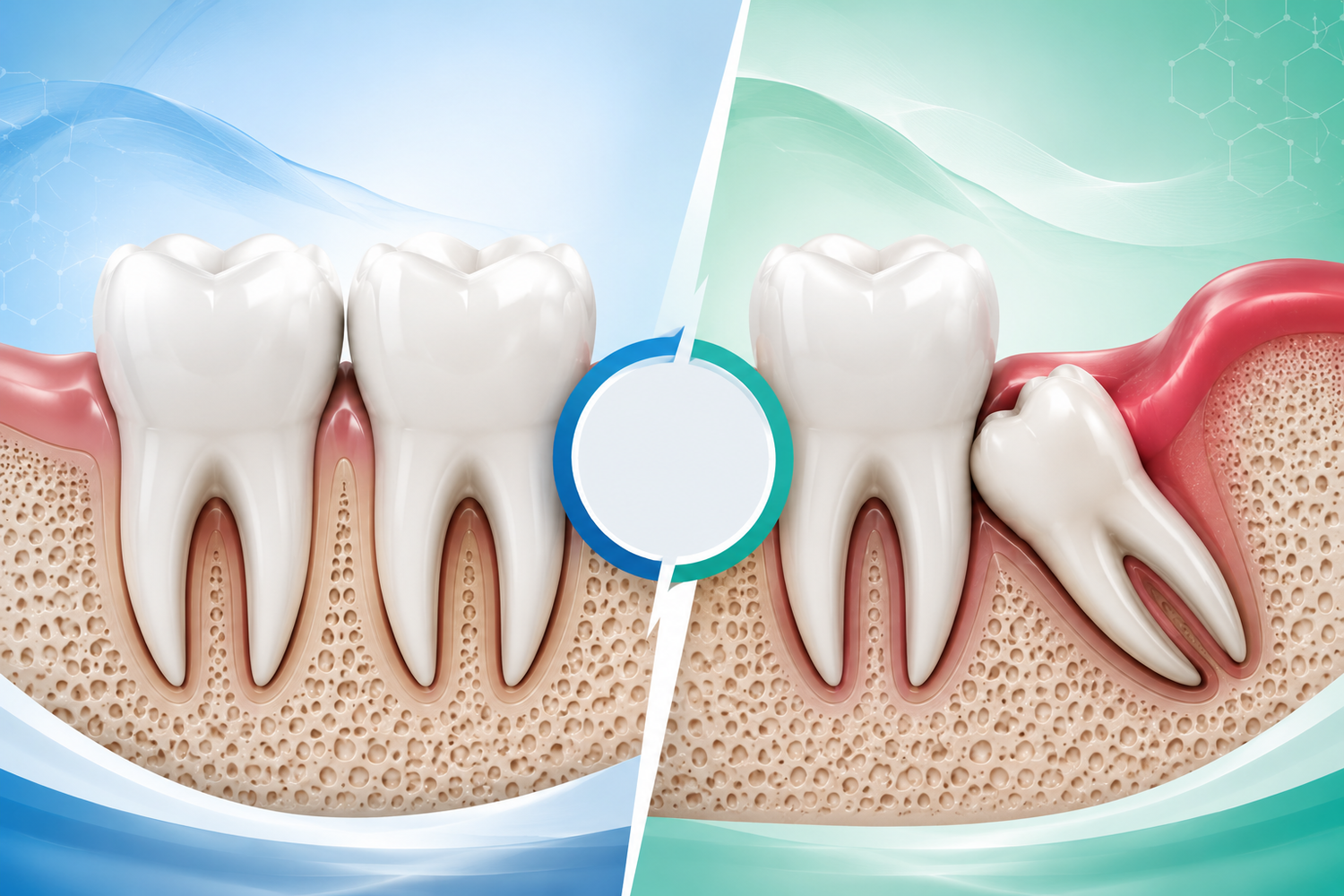
Here's something most people don't realise until they're sitting in a dentist's chair with jaw pain: not all back teeth are the same. A wisdom tooth and a regular molar might look pretty similar on an X-ray, but the way they behave, where they sit, and the problems they cause are quite different. If you've been trying to figure out what's going on in the back of your mouth, this is worth reading before you do anything else.
First, a Quick Recap of How Teeth Work
You don't really need a biology lesson here, but a little context helps. Most of your permanent teeth showed up during childhood, your first big molars around age six, your second set around twelve. By the time you hit your mid-teens, your mouth is basically done. Twenty-eight teeth, all in their place, all with enough room because your jaw grew around them as they came in.
Wisdom teeth are different. They're your third molars, and they show up late, anywhere from 17 to 25, though some people get them earlier, some later, and some never get them at all. By the time they try to come through, the jaw is already finished growing. The space is already taken. That single fact is responsible for pretty much every problem wisdom teeth cause.
So What's Actually Different Between a Wisdom Tooth and a Normal Tooth?
The most obvious difference is timing, but that's almost the least important one. The bigger issue is context.
When your regular molars came in as a kid, your jaw made room for them. There were baby teeth holding the spot, then the adult tooth slipped in as the jaw grew. Everything was coordinated. Wisdom teeth don't get that luxury. They arrive uninvited into a mouth that's already full, which is why they so often end up stuck, crooked, or only halfway out.
Normal molars are also genuinely important. Your first and second molars do most of the chewing work your mouth handles every day. Wisdom teeth? They're essentially leftovers from a time when humans ate much coarser food and needed a bigger jaw. Our jaws have gotten smaller over thousands of years, the teeth haven't quite caught up.
Location matters too. Wisdom teeth sit right at the back of your mouth, which sounds obvious, but it means cleaning them properly is genuinely difficult. You're trying to get a toothbrush into a corner most people can barely reach, and flossing back there is its own challenge. Regular molars sit in a much more accessible position, which is why they tend to stay healthier even without extra effort.
Why Wisdom Teeth Are So Much More Likely to Cause Trouble
It comes down to space, or the lack of it.
When a wisdom tooth doesn't have room to come through properly, it becomes what dentists call impacted. It might push sideways into the tooth next to it. It might partially break through the gum and then stop. It might stay completely under the surface. None of these situations are great.
A partially erupted wisdom tooth is probably the most frustrating scenario. There's a flap of gum sitting over part of the tooth, and food gets trapped underneath it constantly. You can't really clean it out. Bacteria build up, the gum gets inflamed and infected, and you end up with a condition called pericoronitis, which is a medical way of saying your gum is angry and infected and you'll definitely know about it.
Impacted wisdom teeth can also press against the roots of your second molar, which is a perfectly healthy tooth that suddenly starts hurting because of pressure from its neighbour. That's not something that happens with normal molars, ever.
One thing people are often surprised by, wisdom teeth can cause headaches. If a wisdom tooth is growing at an angle, creating pressure, or throwing off your bite even slightly, that tension travels. It goes up into the jaw muscles, sometimes into the temples, and you end up with a headache you can't explain. If you've been getting headaches alongside jaw discomfort, it's worth mentioning to your dentist.
The Signs That Something Is Wrong
A normal molar that's healthy doesn't really give you signals. You chew, it does its job, you move on. A wisdom tooth that's causing problems is rarely quiet about it.
Pain at the very back of your jaw that hangs around for more than a couple of days is a clear sign something needs attention. Swelling or redness in the gum around the tooth, bad breath that brushing doesn't fix, a foul taste in your mouth, difficulty opening your jaw fully, these all point to infection or impaction. Pus or discharge anywhere near that area is a sign you need to see someone that day, not next week.
The mistake a lot of people make is waiting to see if it gets better on its own. Dental infections don't really work that way. They tend to get worse, spread, and become more expensive to deal with the longer they're ignored.
Does Every Wisdom Tooth Have to Come Out?
No, and any dentist who tells you every wisdom tooth automatically needs removing isn't giving you the full picture. If yours came in straight, have room, and you can actually keep them clean, there's no urgent reason to pull them.
The problem is that scenario is less common than people hope. Most wisdom teeth either cause active problems or are sitting in a position where problems are only a matter of time. An X-ray will show your dentist what's actually happening, whether the roots are fully formed, which direction the teeth are growing, and whether they're likely to cause issues.
Age matters here too. Younger patients, late teens to mid-twenties, tend to have shorter, less developed roots, which makes extraction simpler and recovery quicker. Waiting until you're in your thirties doesn't make the teeth easier to deal with; if anything, it goes the other way.
If You're in Pain Right Now
Salt water rinses are genuinely useful, warm water, a decent pinch of salt, rinse a few times a day. Cold compress on the cheek for 15 minutes at a time helps with swelling. Ibuprofen will take the edge off if the pain isn't severe.
But be honest with yourself about how bad it is. If you've got a fever, if the swelling is spreading into your cheek or down your neck, if you genuinely can't open your mouth properly, that's not a "wait and see" situation. That's an emergency appointment.
Putting It Together
The difference between a wisdom tooth and a normal tooth isn't just about which one is which. It's about timing, space, function, and how likely each one is to cause you grief. Regular molars are essential, well-positioned, and usually trouble-free. Wisdom teeth are evolutionary baggage that arrive late to a party with no room left, and they make their presence felt.
That doesn't mean yours will be a problem. But it does mean keeping an eye on them, getting regular check-ups, and not brushing off pain that's been sitting in the back of your jaw for more than a day or two. Catching something early is almost always easier, cheaper, and less painful than dealing with it after it's gotten out of hand.